


China - Life World Library
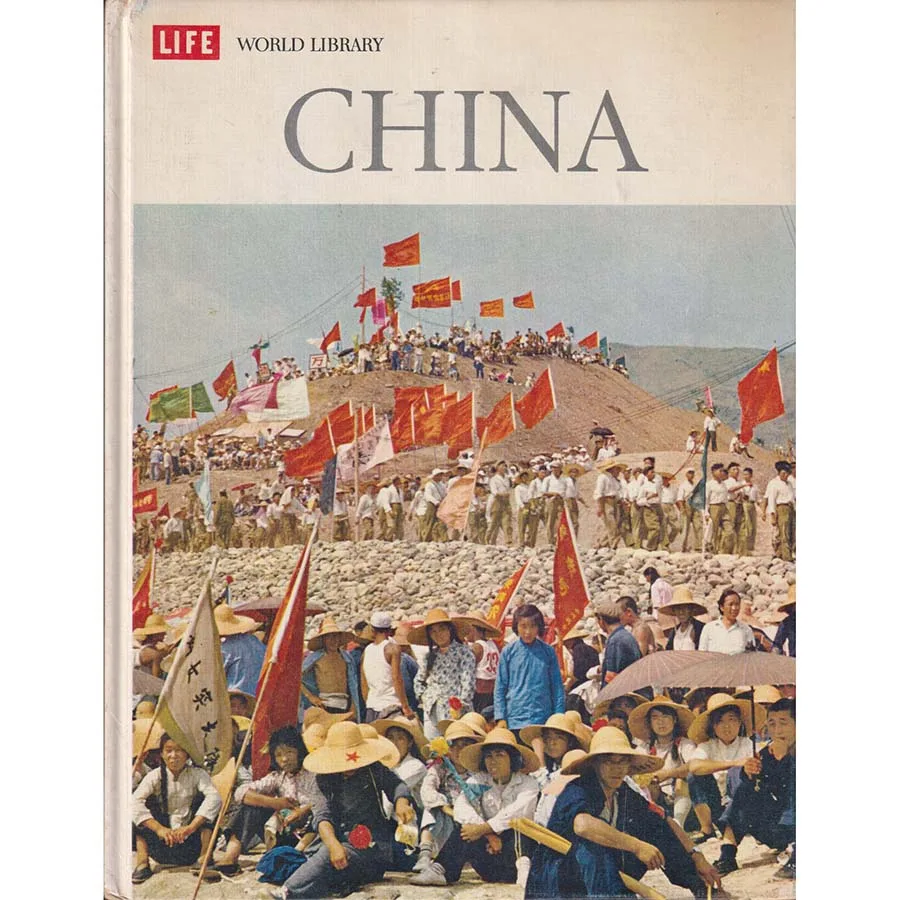
Publisher: Time-Life International
Format: Hardback
ISBN: none
China - Life World Library (1965) by Loren Fessler – Time-Life International
ISBN: None
Condition: Good
China, 1965. A country of immense scale, ancient civilisation, revolutionary politics, vast rural populations, rapidly changing industry and enough historical complexity to make the average family tree look like a shopping list.
Published by Time-Life International as part of its ambitious Life World Library series, Loren Fessler’s China attempts the wonderfully modest mid-century publishing task of explaining one of the largest, oldest and most populous countries on Earth in a single illustrated volume.
And, naturally, it does so with confidence.
This is China under Mao Zedong, at a fascinating and turbulent point in its modern history. The People’s Republic was still relatively young, the upheavals of the Great Leap Forward were recent, relations with both the Soviet Union and the West were tense, and the Cultural Revolution had not yet begun. That would start the following year, in 1966, making this book a particularly interesting snapshot of China immediately before another enormous period of political and social upheaval.
Which means that a book intended as contemporary geography has now become history almost by accident.
The China shown here is a world of huge cities, enormous agricultural regions, collective endeavour, heavy industry, traditional landscapes and a population living through one of the most dramatic transformations of the twentieth century. It is also a China largely inaccessible to ordinary Western travellers at the time, making illustrated books like this far more important than they might seem today.
In 1965 you could not simply open a browser, type "Beijing street view" and spend twenty minutes virtually wandering down an alley before becoming distracted by restaurant reviews.
You needed a book.
Preferably a substantial one.
With maps.
And photographs.
And somebody prepared to explain several thousand years of civilisation without the aid of hyperlinks.
Time-Life specialised in exactly this sort of heroic optimism.
The photographs are particularly valuable now. Scenes that were simply intended to show everyday life in the 1960s have acquired a completely different significance with the passing of time. Streets, clothing, bicycles, workplaces, farms, factories and domestic life are no longer merely illustrations; they are historical documents showing a society that has since changed almost beyond recognition.
Modern China—with its skyscrapers, high-speed railways, smartphones, giant ports and sprawling megacities—would have seemed extraordinary to many of the people photographed here.
In 1965, the bicycle was still one of the defining images of urban China.
Today China can build a railway station roughly the size of a respectable British town while Britain discusses whether the existing station needs another platform.
Times change.
The book also inevitably reflects the assumptions and perspective of Western publishing in the mid-1960s. That is part of its interest. Vintage reference books do not merely tell us about the places they describe; they reveal how those places were understood, interpreted and sometimes misunderstood by outsiders at the time.
There is something endlessly fascinating about reading yesterday’s attempt to explain the present.
Especially when you already know what happened next.
The political sections are naturally among the most historically interesting. Mao’s China was presented to Western readers as something distant, formidable and often mysterious. Cold War attitudes were firmly in place, information was limited, and the People’s Republic remained isolated from much of the Western world.
This was seven years before Richard Nixon visited China.
Six years before the People’s Republic took China’s seat at the United Nations.
And only one year before the Cultural Revolution began transforming Chinese society yet again.
So although this is ostensibly a geographical volume, it now sits almost perfectly on a historical fault line.
Then there is the sheer scale of the country.
China has deserts, mountains, enormous river systems, fertile plains, subtropical regions and areas where simply travelling from one end to the other makes Britain’s concept of "going up north" seem slightly theatrical.
The Yangtze and Yellow Rivers are not merely decorative features on a map. They have shaped civilisation, agriculture, settlement and politics for thousands of years. The Great Wall is not simply a convenient backdrop for travel photographs. And Beijing has been doing the capital-city business for considerably longer than most modern states have existed.
As with the best books in the Life World Library, this one captures not only landscape and politics but ordinary life: work, families, farming, education, industry and the routines through which an enormous country actually functions.
There is also something charming about the physical seriousness of Time-Life books themselves.
They were designed for an era when knowledge occupied furniture.
If you wanted to understand China, you did not carry the information in your pocket. You acquired a large illustrated book, placed it on a shelf beside Canada, Italy and South Africa, and gradually created the impression that the entire planet was under control.
Possessing enough volumes of the series probably qualified you to comment confidently on international affairs at dinner.
Possessing the complete set may have entitled you to your own globe.
For today’s reader, China is arguably more interesting than when it was new. It can be read as geography, political history, social history, photography and an artefact of Cold War publishing all at once.
It is emphatically not a current guide to China.
Do not use it to plan a train journey.
Do not rely on it for visa requirements.
Do not expect the population statistics to be particularly fresh.
And if a restaurant mentioned in a 1965 book is still trading, it probably deserves a heritage plaque.
But as a window into China at a very specific moment in time, it has considerable appeal.
Collectors of Chinese history, communism, Mao-era material, vintage geography, Time-Life books, Cold War history or mid-century photography should find plenty of interest here. It would also make an excellent gift for anyone fascinated by China who has already accumulated enough porcelain dragons, tea sets and decorative objects of uncertain historical accuracy.
Condition: Good. A vintage copy with the normal signs of age and previous ownership expected from a book published in 1965, but remaining in good overall condition and entirely suitable for reading, research, collecting or placing on a shelf while occasionally nodding thoughtfully at it.
A fascinating portrait of China immediately before the Cultural Revolution—a country vastly different from the China of today, captured at precisely the point when nobody involved in producing the book could know quite how dramatic the next few decades were going to be.
Sold by Crappy Old Books, where history comes without pop-up adverts, algorithmic recommendations or a requirement to accept 437 tracking cookies before discovering what happened in 1965.
Keep browsing: See more Travel books Other books by Loren Fessler
